
CTT Consciousness
Consciousness, Identity, and Causal Immortality
Constant Time Theory (CTT) begins with a simple but far-reaching idea:
Reality endures not because it was created once, but because it is continually renewed.
From this single principle—persistence through renewal—we can reinterpret some of humanity’s deepest questions about consciousness, identity, death, and meaning without appealing to the supernatural.
Consciousness as Enduring Renewal
In CTT, consciousness is not a mysterious inner substance or detached soul.
It is:
Enduring biological renewal with memory continuity in the present.
This means:
Consciousness is continuous with life, not separate from it.
Memory exists across genetic, cellular, neural, and narrative layers.
Greater temporal integration of memory produces deeper awareness.
So consciousness forms a continuum:
Cells → minimal persistence
Animals → integrated experience
Humans → reflective self-awareness
No sudden magical boundary—only deepening endurance through time.

Identity as a Living Process
CTT defines personal identity as:
The continuous persistence of biological memory across renewal.
From this follow several important insights:
Identity is not fixed; it evolves gradually.
Ageing and brain injury transform the self rather than erase it.
No single component—brain, memory, or personality—alone is the person.
The self is therefore a dynamic process, not a permanent object.
We do not remain the same by resisting change, but by continuing through it.
Death and the End of Personal Continuity
Within CTT:
Death is the cessation of biological renewal.
Without renewal, memory continuity ends.
Therefore, personal identity does not survive death.
This rejects traditional ideas of:
Souls departing the body
Preserved personalities in an afterlife
Eternal personal consciousness
Yet this is not the end of persistence.
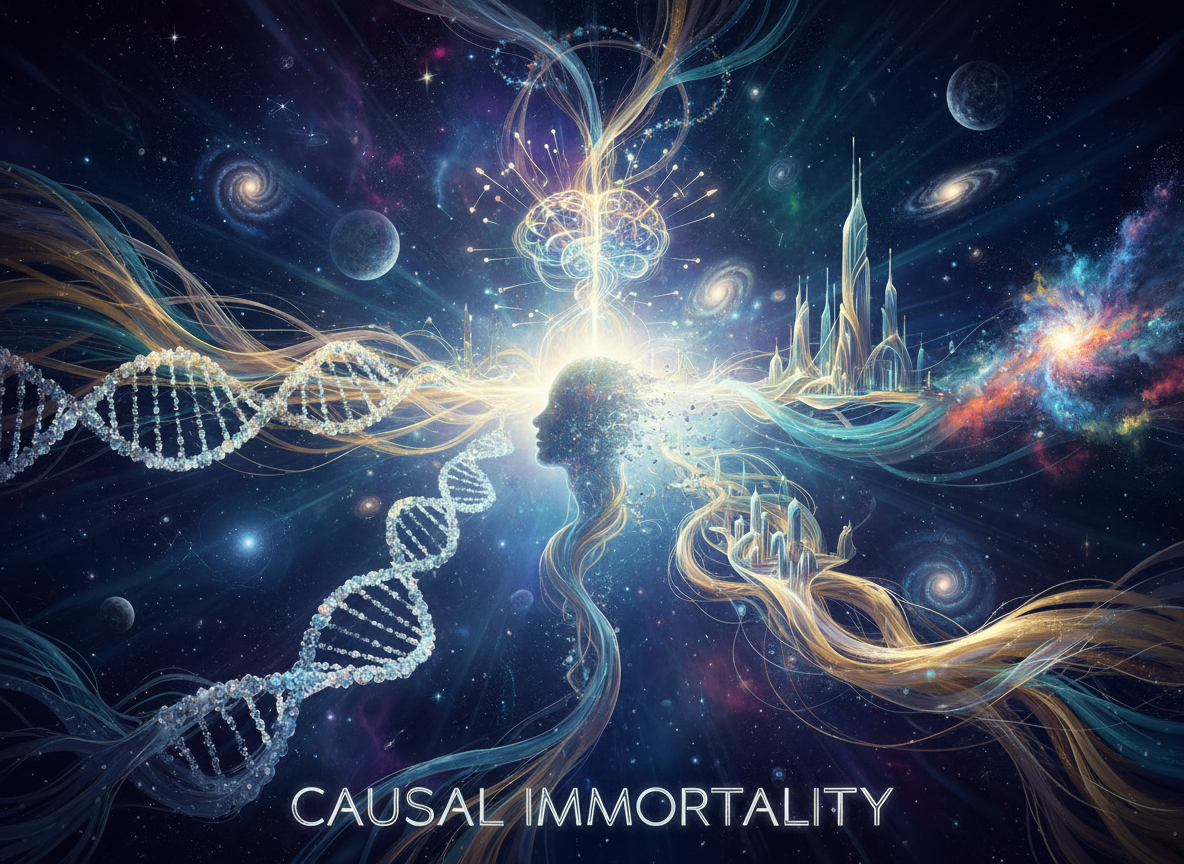
Causal Immortality
Although the personal self ends, causal influence does not.
Every life reshapes the future through lasting patterns in:
Biology — descendants and evolutionary pathways
Minds — memories, values, and learned behaviours
Society — ideas, institutions, and culture
Physics — irreversible changes to matter and energy
This continuing influence is:
Causal immortality
— the persistence of a life’s effects within the universe’s ongoing renewal after biological renewal ends.
Meaning therefore shifts from:
“Will I continue?” to “What will continue because I existed?”
Darwin and Strong Causal Persistence
A clear historical example is Charles Darwin.
Though his life ended in 1882:
Modern biology, medicine, and genetics depend on evolution by natural selection.
Each generation that learns evolution re-instantiates his influence.
His ideas continue to shape humanity’s understanding of life.
Darwin’s personal story ended, but the patterns he set in motion still endure.
This is causal immortality in one of its purest forms.
Ethical Implications of CTT
If causal immortality is real, CTT quietly implies an ethic:
A meaningful life is one that leaves constructive persistence in the future.
Actions differ not only in the moment, but in how long their effects endure:
Knowledge expands future possibilities.
Compassion stabilises human relationships.
Creativity reshapes culture and perception.
Harm propagates suffering forward in time.
Ethics becomes:
Responsibility for the patterns we set into motion.
We may not continue personally, but what we cause will.
A Quiet Conclusion
CTT offers a third path between:
Religious eternal survival, and
Total existential disappearance.
Instead:
The self ends,
Yet the effects endure within universal renewal.
So the deepest truth may be:
We do not endure because we live forever.
We endure because what we change continues to renew after we are gone.
And in that sense, every life that leaves the world more coherent, more compassionate, or more aware achieves a form of immortality fully grounded in reality itself.