
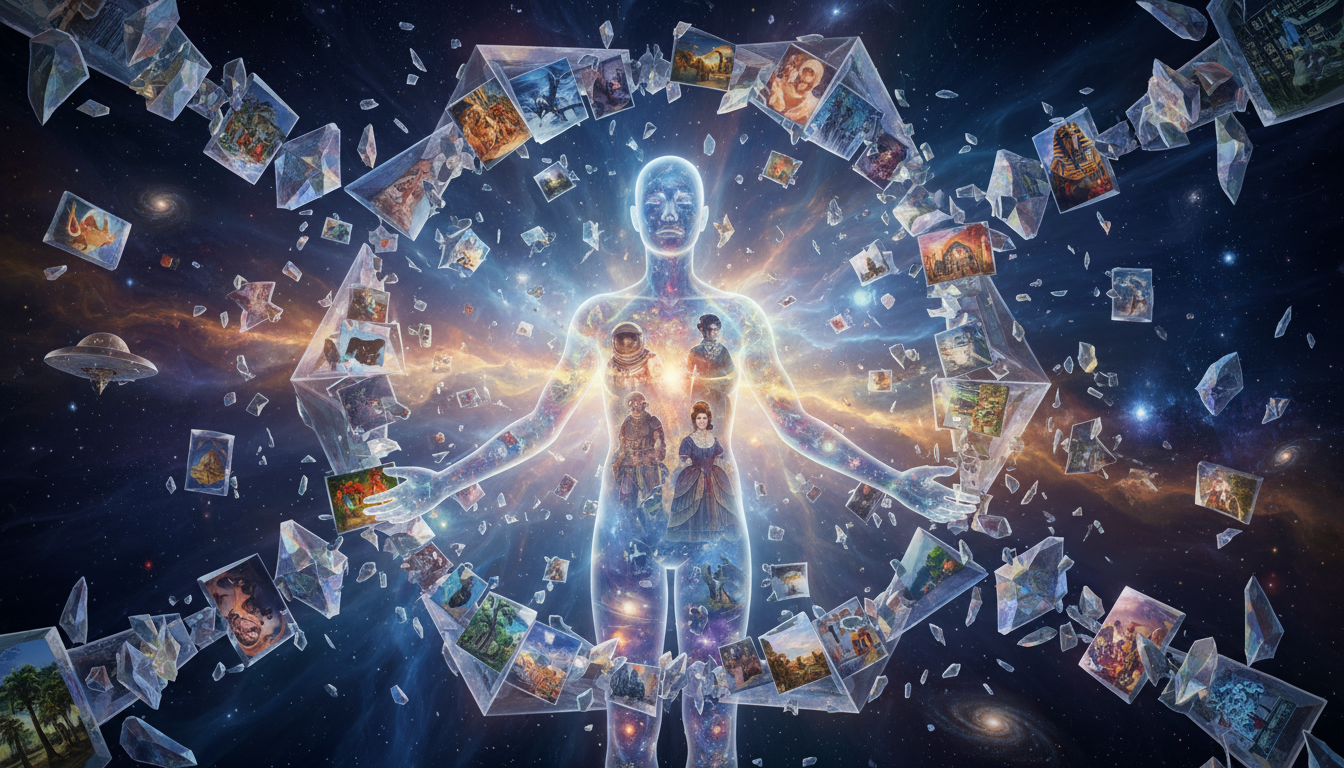
Déjà Vu, Past Lives, and the Illusion of Temporal Memory
Experiences such as déjà vu, past-life memories, and a deep sense of temporal familiarity are among the most compelling aspects of human consciousness. They feel vivid, personal, and often profoundly meaningful. Across cultures and eras, these experiences have led people to conclude that consciousness may move backward and forward through time — or that we have lived before, many times.
Constant Time Theory takes these experiences seriously.
But it draws a different conclusion.
In philosophical terms, many reincarnation-style explanations represent an over-interpretation of data, not an explanation.
CTT does not require that leap.
Why these experiences feel so real
Déjà vu and “past-life” impressions are not vague sensations. They are often:
emotionally charged
richly detailed
accompanied by a strong sense of certainty
The mistake is not in trusting the experience — it is in assuming that the only explanation is literal temporal repetition of the self.
Human cognition is not organised as a linear archive of moments. Memory is associative, pattern-based, and heavily influenced by emotional reinforcement. When a present situation closely aligns with an existing internal pattern, the brain may generate a powerful sense of familiarity without a clear source.
The experience is real.
The interpretation is optional.
Déjà vu through the lens of CTT
In Constant Time Theory, reality persists through continuous renewal, not smooth flow. Structures — including mental and emotional patterns — endure by being repeatedly re-instantiated within a temporal field.
Déjà vu occurs when:
a present configuration closely matches a previously reinforced pattern
the renewal alignment is unusually tight
the mind recognises familiarity without locating a chronological origin
The result is a sensation of having been here before, even though no such personal history exists.
What is being recognised is structural similarity, not a past event.
Past-life experiences reconsidered
Reports of past-life memories often arise in contexts involving:
suggestion or expectation
altered states of consciousness
emotionally charged narratives
cultural reinforcement
CTT offers a simpler and more coherent explanation.
The brain is exceptionally good at:
absorbing narrative structure
internalising historical and symbolic material
forming identity-shaped patterns from external information
Under certain conditions, these patterns can be accessed without their original context. When they surface, the mind instinctively frames them as personal memory — because identity is the organising principle through which meaning is interpreted.
No migrating soul is required.
No previous lifetime needs to be assumed.
Why the reincarnation explanation is unnecessary
Claims of repeated personal lifetimes attempt to explain:
familiarity
emotional resonance
narrative coherence
But they introduce far more assumptions than the data requires.
CTT explains the same phenomena by recognising that:
time does not carry experiences forward
structure persists through renewal
identity itself is a reinforced temporal pattern
What endures is not a travelling self, but patterns capable of persistence.
Taking experience seriously — without excess
Many contemporary writers and researchers have done important work in legitimising these experiences, pushing back against the idea that they should simply be dismissed as illusion or error. That contribution matters.
Where Constant Time Theory differs is in refusing to turn extraordinary experience into extraordinary metaphysics.
CTT does not deny what people feel.
It questions what those feelings require us to believe.
By grounding déjà vu and temporal familiarity in structure rather than repetition, CTT offers an explanation that is:
coherent
parsimonious
and compatible with both human experience and physical causality
A quieter conclusion
We feel as though we have lived before not because we have travelled through time,
but because time itself does not behave as we imagine.
Continuity is not something time gives us.
It is something time continually rebuilds.