
Ageing, Explained Through Constant Time Theory
Constant Time Theory (CTT) starts from a simple observation:
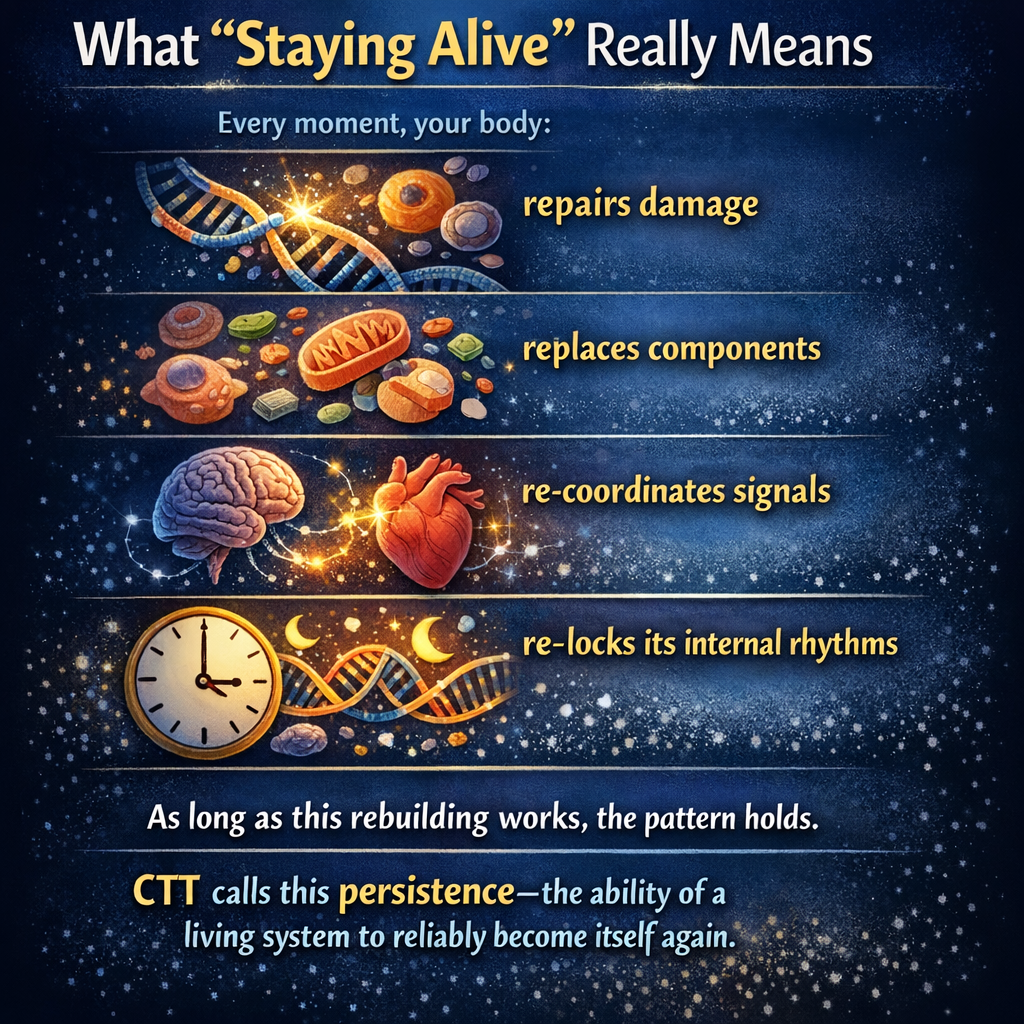
Living things don’t stay alive because their matter stays the same —
they stay alive because their pattern keeps being rebuilt.
Your body replaces most of its atoms over time.
Yet somehow, you remain recognisably you.
CTT says this is because life is not a thing, but a process — a pattern that must be continuously re-created. Time, in this view, is not something we drift through. It is the condition that allows rebuilding to happen at all.
What Is Constant Time Theory, in Simple Terms?
So What Is Ageing, Really?
We usually think of ageing as:
time passing,
damage accumulating,
or the body “wearing out”.
CTT offers a different explanation.
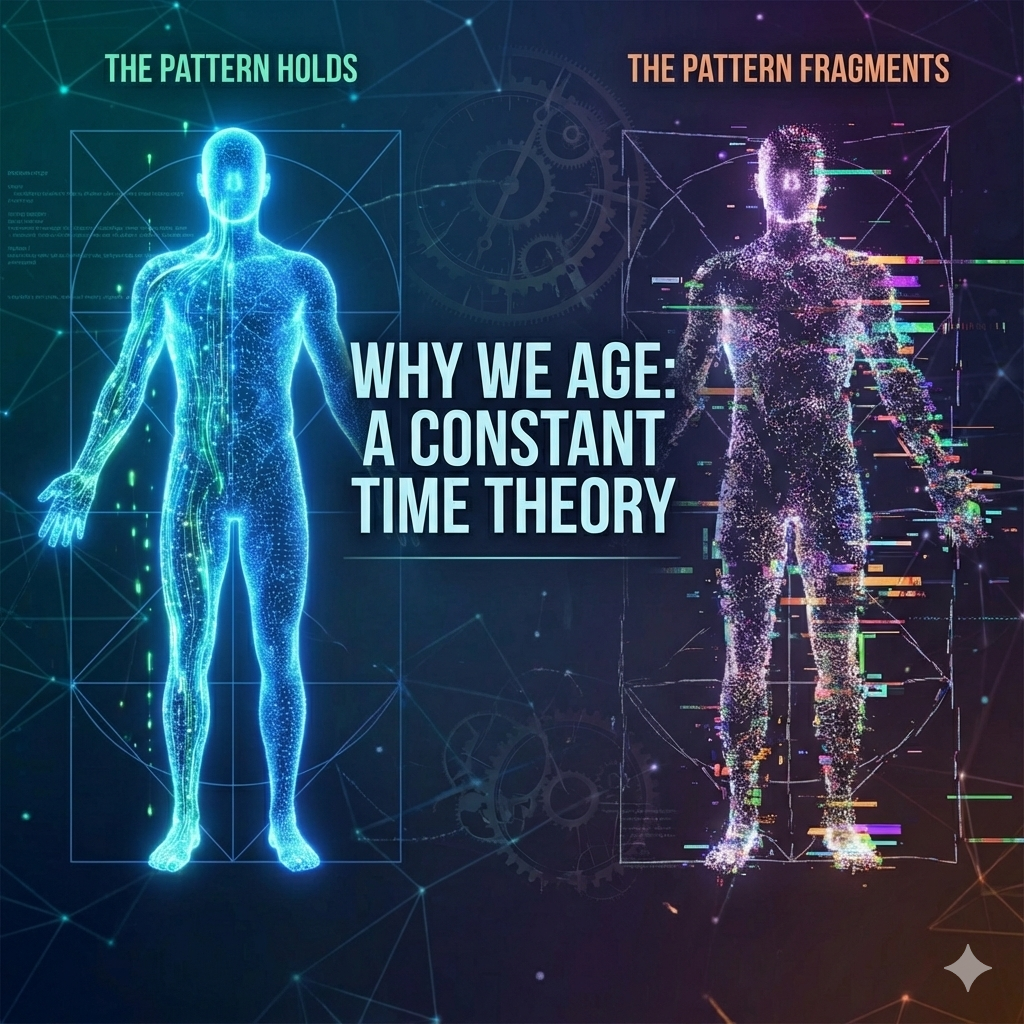
Ageing is what happens when a living system struggles to rebuild itself as cleanly as it once did.
Early in life, the body rebuilds itself with ease.
Later, the rebuilding still happens — but it becomes noisier, slower, and less precise.
Eventually, the system reaches a point where it can no longer reliably become the same version of itself again.
That is what ageing is, in CTT terms.
Why Does Ageing Feel Slow… Then Sudden?
One of the puzzles of ageing is this:
We cope with damage for decades.
Then, often quite suddenly, things unravel.
CTT explains this naturally.
As long as the body’s ability to repair, regulate, and coordinate outweighs the damage it faces, the pattern holds. But this balance is not linear.
There is a limit.
Once the effort required to rebuild the pattern exceeds the system’s ability to do so, decline accelerates rapidly. This is why ageing often feels like a tipping point rather than a smooth slide.
Why Does Everything Get More Erratic With Age?
As people age, many systems become more variable:
sleep fragments,
heart rhythms lose regularity,
reactions slow and fluctuate,
recovery takes longer.
CTT interprets this as rebuilding jitter.
The system is still being rebuilt each moment — but not with the same precision. Each “now” lands slightly off from the last. Over time, those small misalignments accumulate.
This is why instability often appears before obvious failure.
Why Do Things Go Wrong Before the Body “Runs Out”?
In later life, we often see:
confusion before neurons disappear,
immune misfires before cells die,
loss of coordination before loss of tissue.
CTT predicts this.
Because identity doesn’t live in the parts — it lives in the relationships between them.
You can still have all the components, all the energy, all the raw materials — and yet lose the ability to coordinate them into a coherent whole.
Ageing, then, is not primarily about running out of fuel.
It’s about losing the ability to stay in sync.
Why Do Some Interventions Slow Ageing?
Many life-extending or health-extending interventions:
improve repair,
enhance clean-up processes,
stabilise coordination,
reduce internal noise,
without eliminating damage entirely.
CTT predicts this.
Ageing is not caused simply by damage — it is caused by insufficient capacity to deal with it. Strengthen the capacity, and you delay the point of failure, even if the world remains harsh.
What About Cancer and Other Age-Related Diseases?
CTT makes an important distinction.
Not everything that persists is good.
Some age-related conditions are not failures of persistence, but misdirected persistence — alternative patterns that stabilise when the original one weakens.
Cancer, for example, can be understood as a competing pattern that survives even as the organismal pattern collapses.
Ageing, then, is not just decline — it is a struggle over which patterns endure.
How Could This Idea Be Wrong?
CTT is not beyond challenge. It would be wrong if we found that:
ageing happens smoothly, with no tipping points,
identity is lost only after the body runs out of material,
systems fail without warning or instability,
repair capacity can be overwhelmed without consequences,
or identity can persist without ongoing rebuilding.
So far, ageing biology suggests the opposite — but the theory stands or falls on evidence, not belief.

The Core Idea, Simply Stated
Ageing is not time catching up with us.
It is the moment a living system can no longer reliably become itself again.
Life endures through repetition.
Ageing is the cost of that repetition under limits.
And death, in this view, is not time stopping —
but persistence failing.