

CTT in Context
How Constant Time Theory relates to contemporary philosophy and physics.
CTT does not arise in isolation. It sits alongside - and in conversation with - several serious attempts to understand reality beyond physicalism.
Shared Concerns
Constant Time Theory arises from questions increasingly shared across contemporary philosophy and theoretical physics. These questions do not challenge science itself, but whether its explanations begin at the right level.
Reality as process, not object
Across modern frameworks, reality is no longer treated as a finished object, but as something that happens. Change and persistence are not secondary features — they are central problems.
CTT aligns with this shift, treating existence itself as an ongoing event.
The status of the present
Block-universe models struggle to account for lived experience, agency, and change, while purely subjective accounts of “now” fail to explain shared structure and physical limits.
CTT takes seriously the possibility that the present moment is ontologically fundamental.
Beyond physicalism
Traditional physicalism explains structure well, but meaning poorly. It describes how things behave, yet struggles to explain why experience exists, why reality changes, and why continuity persists at all.
CTT shares this dissatisfaction and looks for a deeper starting point.

Analytic Idealism, especially as articulated in recent literature by Bernardo Kastrup, argues that phenomenal consciousness is the primary substrate of existence, with individual minds as dissociated segments of universal consciousness.
Appearance versus essence
There is growing recognition that physics describes how reality behaves, not what it is in itself. Physical laws may reflect stable patterns rather than ultimate foundations.
CTT operates within this distinction, seeking the conditions under which such patterns endure.
A shared starting point
These concerns form the common ground from which Constant Time Theory should be understood. From here, meaningful differences — and deeper proposals — can be explored.
From shared concerns to Analytic Idealism
These concerns have led a number of contemporary thinkers to question whether reality is best understood as fundamentally physical at all.
One of the most developed and influential responses to this question is Analytic Idealism, which offers a coherent, non-supernatural account of reality grounded in experience rather than matter.
It is therefore a natural point of comparison for Constant Time Theory.
Analytic Idealism and Constant Time Theory
Analytic Idealism, as articulated by Bernardo Kastrup, begins from a simple but radical claim:
consciousness is fundamental, and what we call the physical world is its outward appearance.
In this view, the universe is not composed of matter that somehow produces experience. Instead, matter, spacetime, and physical laws are understood as representations — ways in which underlying experiential processes present themselves when viewed from the outside.
This move allows Analytic Idealism to avoid many long-standing problems in philosophy of mind, including the hard problem of consciousness and the explanatory gap between matter and experience.
Constant Time Theory shares much of this motivation. It likewise rejects the idea that reality is built from inert matter in a pre-existing spacetime. Where it differs is in the level at which it locates the fundamental condition of existence.
While Analytic Idealism begins with consciousness itself, CTT begins with temporal renewal — the continuous re-instantiation of the present moment that allows any structure, physical or experiential, to persist at all.
From here, the two frameworks can be seen not as competitors, but as addressing different aspects of the same underlying question.
In brief
Analytic Idealism focuses on what reality is like from within experience.
Constant Time Theory focuses on how continuity is possible in a present-only universe.
Together, they address complementary aspects of the same underlying problem.

Where the two approaches differ
The difference between Analytic Idealism and Constant Time Theory is not a disagreement over facts, but a difference in ontological starting point.
Both reject physicalism. Both take experience seriously. Where they diverge is in what they take to be fundamental.
Consciousness or condition?
Analytic Idealism, as developed by Bernardo Kastrup, begins with consciousness itself.
In this view, experience is primary, and the physical world is its extrinsic appearance. Time, space, and matter are understood as representational structures within experience.
Constant Time Theory takes a different first step.
CTT does not deny the primacy of experience in meaning or value. Instead, it asks a prior question:
What allows anything — physical or experiential — to persist at all?
Its answer is temporal renewal.
Continuity without timelessness
This leads to a further distinction.
Analytic Idealism can be read as allowing a form of timeless continuity at the level of universal mind, even if time is not fundamental.
CTT resists this move. It proposes that continuity does not arise from timeless existence, but from successful re-instantiation across successive present moments.
Nothing endures by existing forever.
Things endure because they are repeatedly renewed.
Time as representation versus time as renewal
In Analytic Idealism, time is generally treated as a feature of how experience is structured. It orders events within consciousness, but is not itself the underlying condition of existence.
In CTT, time is not merely representational. It is the active process by which the present moment is continuously re-instantiated. Without this renewal, there is no persistence, no continuity, and no enduring structure — mental or physical.
From this perspective, consciousness does not exist outside time, nor does it float timelessly beneath it. It endures through renewal.
A difference of depth, not direction
Importantly, this difference is not adversarial.
Analytic Idealism offers a powerful account of the interior nature of reality.
CTT offers an account of the condition under which any interior can persist.
Where Analytic Idealism begins with consciousness and explains the world,
CTT begins with renewal and explains why there can be a world at all.
CTT as a foundational layer beneath Analytic Idealism
Constant Time Theory does not seek to replace Analytic Idealism, nor to reinterpret its central claims about experience. Instead, it proposes a deeper explanatory layer beneath them.
Analytic Idealism offers a compelling account of what reality is like from within. It explains why experience is primary, why meaning cannot be reduced to matter, and why the physical world should be understood as appearance rather than essence.
CTT asks a different, prior question:
What must be true for any reality — experiential or otherwise — to continue existing at all?
Persistence requires a condition
Experience, however fundamental, is not static. It changes, unfolds, and yet somehow remains continuous. Analytic Idealism describes this continuity, but does not require a detailed account of how it is sustained.
CTT proposes that continuity itself requires an active condition:
the continuous renewal of the present moment.
From this perspective, consciousness does not float timelessly beneath the world, nor does it require a permanent past to endure. It persists because its structure is successfully re-instantiated, moment by moment.
Renewal beneath experience
Seen this way, Analytic Idealism and CTT address different layers of the same reality:
Analytic Idealism describes the intrinsic nature of what exists
CTT describes the temporal condition that allows anything to endure
Experience gives reality its interior.
Renewal gives reality its continuation.
CTT therefore operates beneath the level at which Analytic Idealism begins, without contradicting its claims about meaning, mind, or appearance.
A stabilising foundation
By grounding continuity in renewal rather than timeless existence, CTT avoids introducing hidden eternities — whether physical or mental.
Nothing endures because it exists forever.
Things endure because they continue to happen.
In this sense, CTT may be understood as a stabilising ontological foundation upon which Analytic Idealism can comfortably rest.
Different questions, shared direction
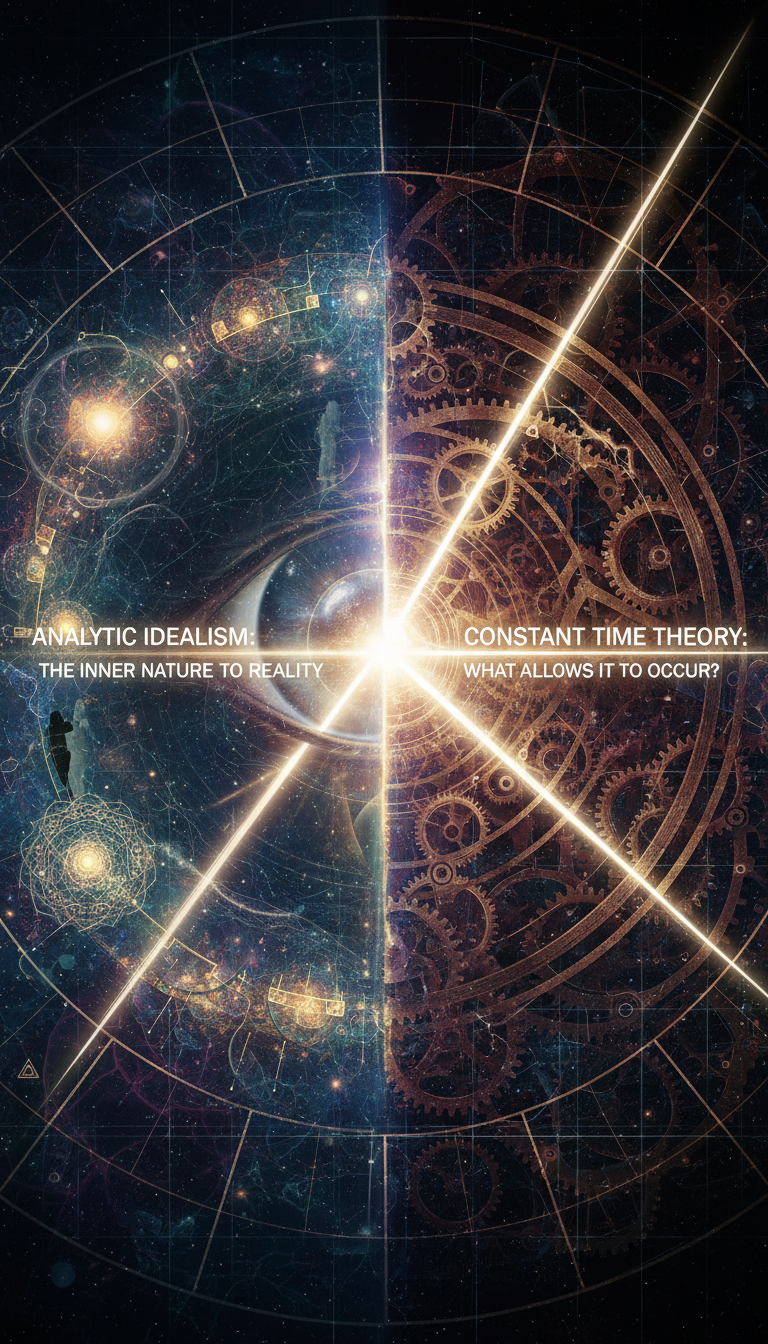
Analytic Idealism asks: What is the world made of, really?
CTT asks: What allows any world to keep occurring at all?
They move in the same direction, but at different depths.
Why this matters
How we understand the foundations of reality shapes how we think about time, meaning, identity, and responsibility.
If reality is treated as a completed object — whether physical or mental — change becomes illusory and agency difficult to justify. If it is treated as purely subjective, shared structure and physical limits become hard to explain.
Analytic Idealism and Constant Time Theory both avoid these extremes.
Analytic Idealism explains why experience cannot be reduced to matter, restoring meaning and interiority to the universe. Constant Time Theory explains how continuity is possible without invoking a permanent past, a timeless substrate, or a block universe.
Together, they offer a picture in which:
Reality is ongoing, not static
The present moment is fundamental, not incidental
Continuity arises through renewal, not eternal existence
Meaning is grounded in experience, without abandoning structure or law
This matters because it reframes long-standing debates about free will, personal identity, ethics, and cosmology — not by choosing sides, but by asking a deeper question about what allows anything to endure at all.
If Analytic Idealism explains what the world is,
Constant Time Theory asks the quieter, prior question:
What must be true for any world to keep happening?