
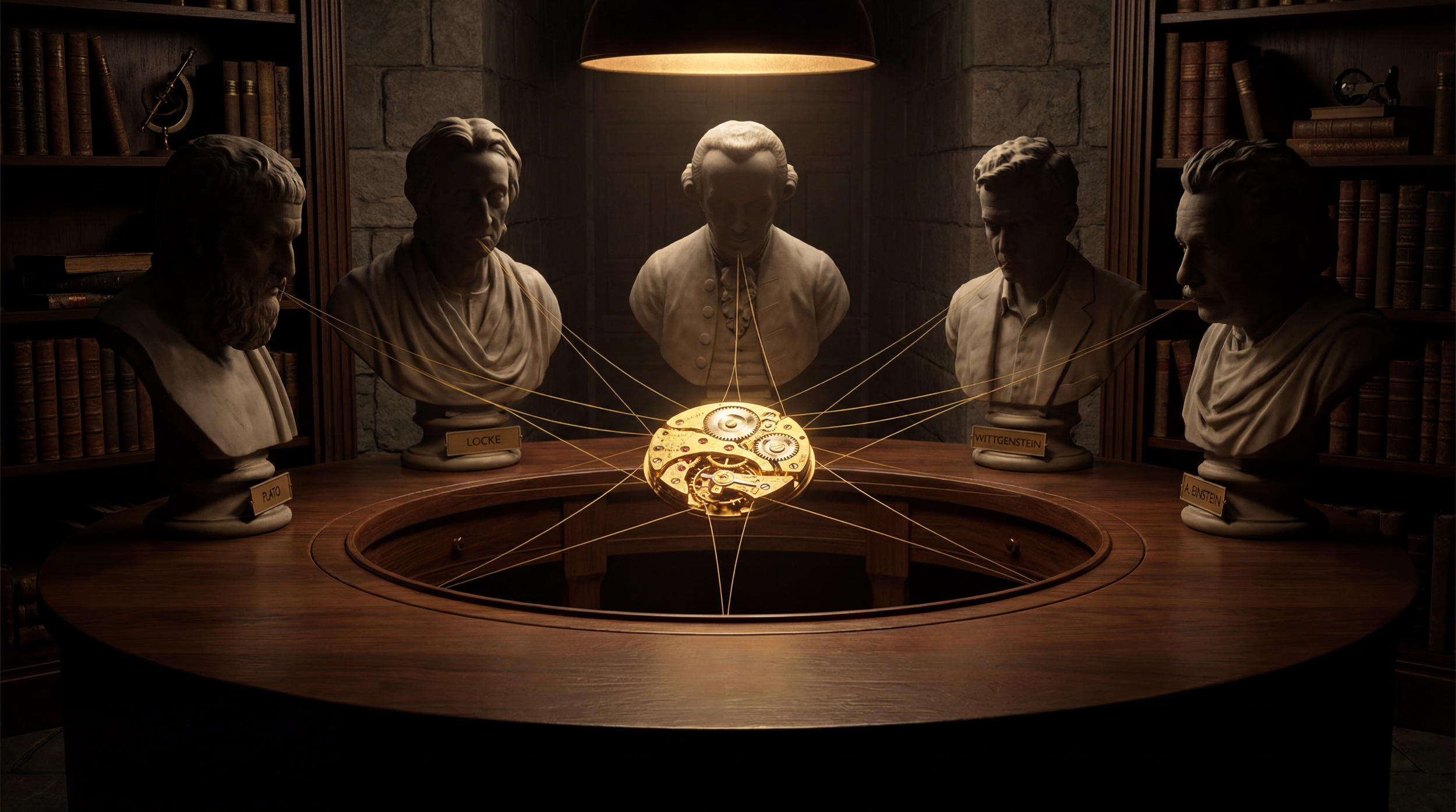
The Unanswered Questions of Philosophy
Revisited Through
Constant Time Theory
For more than two thousand years, philosophers have attempted to understand the nature of reality. Across centuries and cultures, the same fundamental questions continue to arise:
What is time?
How do we know anything?
What allows things to persist while they change?
The remarkable feature of philosophy is that many of its greatest thinkers discovered genuine features of reality, yet their interpretations often diverged sharply. As a result, philosophical history reads less like a sequence of final answers and more like a series of powerful insights, each illuminating a different aspect of the same puzzle.
Constant Time Theory (CTT) proposes that many of these long-standing tensions may stem from a shared misunderstanding about the nature of time itself. If time is not merely a measure of change but the continual renewal of existence, then some philosophical disagreements begin to look less like contradictions and more like partial glimpses of a deeper process.
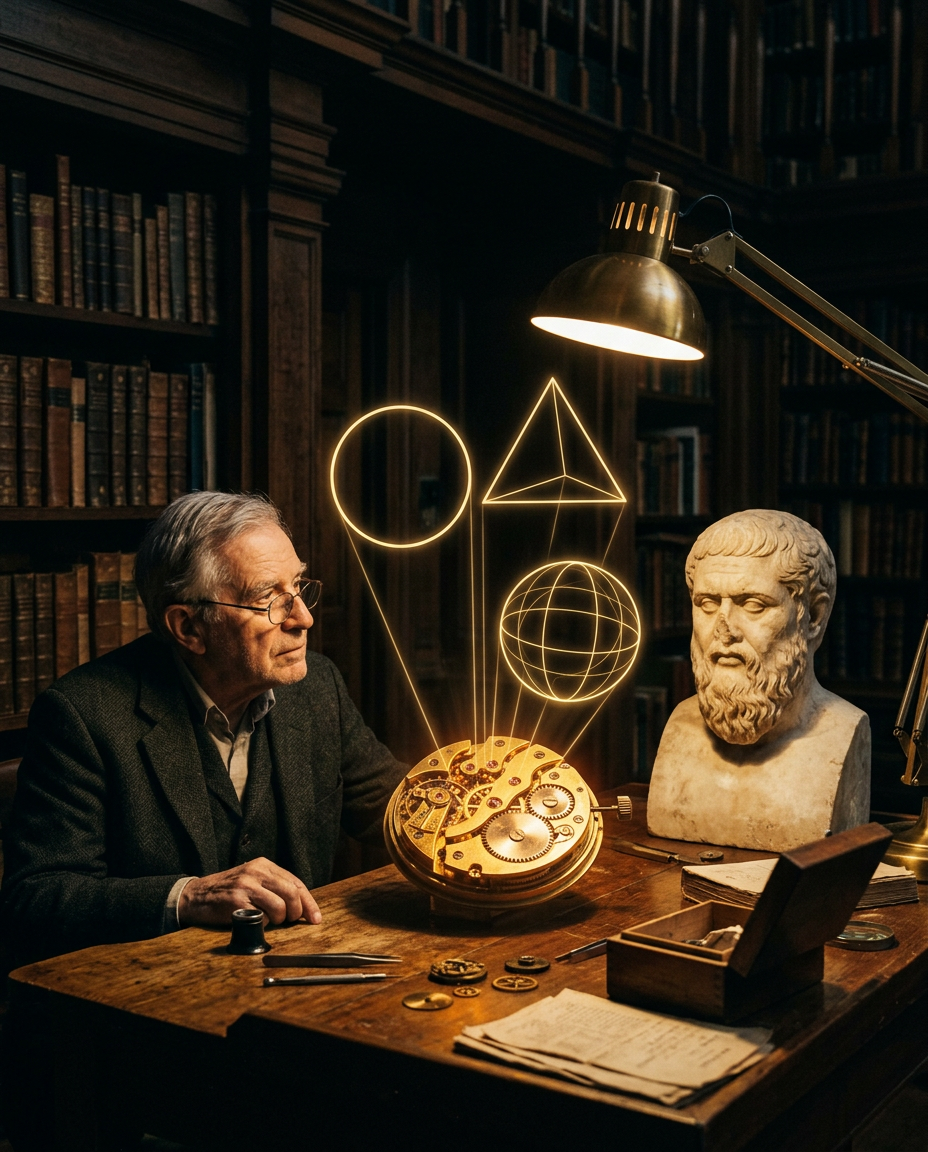
PLATO
Forms and the Search for Permanence
Plato and the Problem of Permanence
Plato believed that perfect forms existed beyond the world of change.
But what if those forms were not elsewhere at all — what if they were woven into the mechanism of reality itself?
More than two thousand years ago, Plato recognised a deep puzzle about reality.
The world we experience is constantly changing. Trees grow and decay. People age. Cities rise and fall. Nothing in the physical world appears perfectly stable. Yet at the same time, certain things seem to possess a form of permanence. Mathematical truths remain true regardless of circumstance. A circle retains its definition whether drawn in sand, ink, or imagined in the mind.
Plato resolved this tension by proposing the existence of Forms — perfect, eternal patterns that exist beyond the physical world. In his view, the objects we encounter in everyday life are only imperfect reflections of these ideal structures. A drawn circle approximates the perfect Form of a circle. A just society attempts to mirror the Form of justice.
The idea was powerful because it explained how stable knowledge could exist in an unstable world.
Yet Plato’s solution created a new difficulty. If Forms exist in a separate, timeless realm, how do they interact with the changing physical world we inhabit?
This question remained one of the enduring challenges of Plato’s philosophy.
Constant Time Theory offers a different way of understanding the stability Plato recognised. In a universe where reality is continually renewed rather than simply flowing through time, stable patterns do not require a separate realm of existence. Instead, they persist because they are continually reinstantiated through the renewal of reality itself.
Mathematical structures, physical laws, and enduring patterns of nature can therefore be understood as stable informational structures that survive each renewal of the present.
In this sense, Plato may have correctly identified the existence of deep structural patterns in reality. What he lacked was a physical explanation for why those patterns endure.
Constant Time Theory suggests that what Plato called Forms may simply be the persistent structures of a renewing universe.
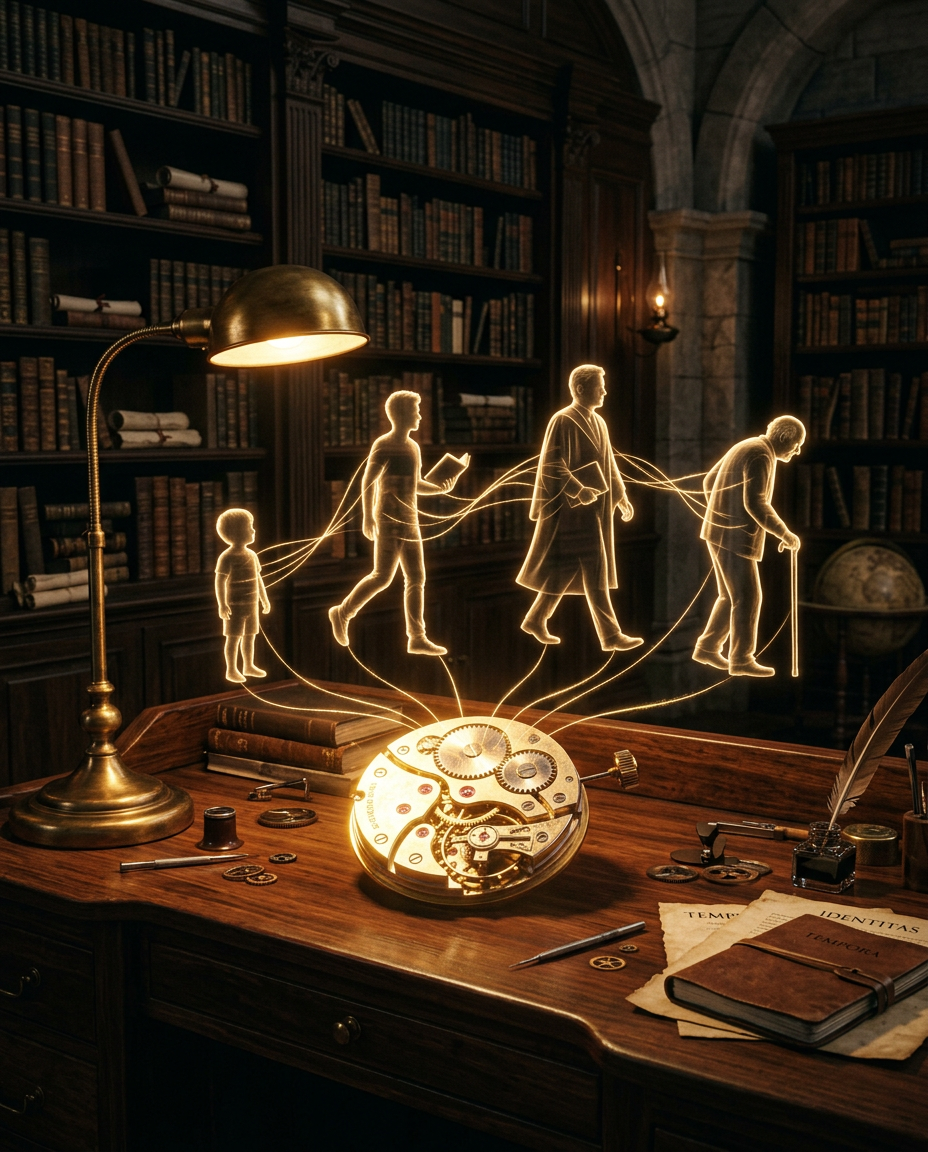
What Makes You the Same Person
Over Time?
JOHN LOCKE
John Locke and the Problem of Identity
If Plato asked how permanent truths could exist in a changing world, John Locke asked a more personal question: what makes something remain the same thing through time?
At first glance, the problem seems straightforward. A child becomes an adult. A tree grows from a sapling into an oak. The materials composing these things change continuously, yet we still recognise them as the same individual persisting across time.
Locke argued that personal identity does not reside in the physical substance of the body. Instead, it arises from continuity of consciousness. A person remains the same person because their memories and experiences form a connected chain.
This insight was remarkably modern. Locke recognised that identity is not simply a matter of matter, but of informational continuity.
However, Locke’s explanation left an important question unresolved. If the physical components of reality are constantly changing, what mechanism allows information — such as memory and identity — to persist from one moment to the next?
Constant Time Theory approaches this question through the interaction of two aspects of time: renewal and structure.
In CTT, the renewing aspect of time (Θ_E) continually reinstantiates the present moment. Alongside this operates Θ_S, the structural mode of time responsible for organising and preserving the informational configuration of reality.
Within this structural field, patterns of information — including biological structures, neural networks, and memory — are maintained as stable configurations. As reality renews, these configurations are reinstantiated in successive moments, allowing the informational pattern that defines a person to persist.
Identity, therefore, does not require the same matter to endure. What endures is the structured informational pattern encoded within Θ_S, carried forward as each moment of reality is renewed.
In this way, Locke correctly recognised that personal identity depends on continuity of memory. Constant Time Theory suggests that this continuity is possible because the informational structure of a person is preserved within the structuring dimension of time itself.
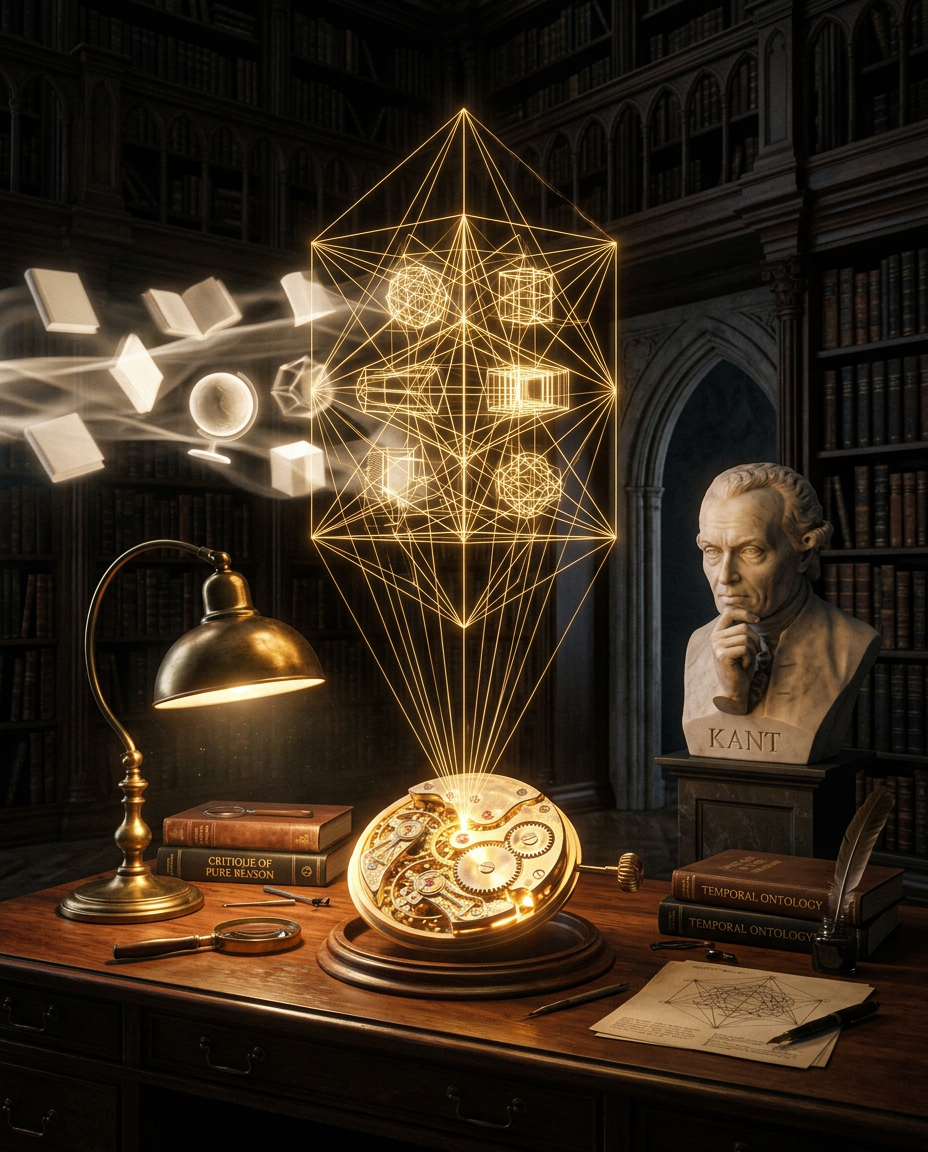
IMMANUEL KANT
Why Reality Appears Ordered
Kant and the Structure of Experience
If Locke asked what allows identity to persist through time, Immanuel Kant asked an even deeper question: how is experience itself possible?
Human beings do not encounter reality in a raw, unstructured form. Everything we perceive appears organised within a framework. Objects occupy space. Events occur in time. Causes produce effects. Our experience of the world is not chaotic but ordered.
Kant argued that this order does not arise solely from the external world. Instead, he proposed that the human mind contributes the framework through which reality is understood. In his view, space and time are forms of intuition — fundamental structures that make experience possible.
This was a revolutionary insight. Rather than treating space and time as simple features of the external world, Kant suggested they are part of the structuring conditions of perception itself.
Yet this raises an important question. If the structure of time belongs primarily to the mind, why does the universe appear so remarkably compatible with it? Why does mathematics describe physical reality so effectively? Why does the world behave in ways that align so closely with the frameworks through which we perceive it?
Constant Time Theory approaches this problem from a different direction. Rather than locating the origin of structure entirely within the mind, CTT proposes that time itself operates as a temporal field with both renewing and structuring properties.
The renewing aspect of time (Θ_E) continually reinstantiates the present moment. Alongside this operates (Θ_S), the structural mode of the temporal field that organises and preserves the informational configuration of reality.
Within this field, relationships between events are maintained through causal structure. Causality is required for any change to occur — whether in physical processes or in the activity of the human mind. Even thought itself unfolds through sequences of cause and effect.
This suggests that time cannot simply be a feature of perception. The causal ordering required for change implies that time must be a fundamental property of reality itself.
In this sense, Kant correctly recognised that experience depends upon an underlying framework that organises events and relations. What remained unresolved in his philosophy was the origin of that framework.
Constant Time Theory proposes that this ordering arises from the structuring properties of the temporal field, within which both physical processes and human cognition unfold.
WITTGENSTEIN
The Problem of Describing Reality
Wittgenstein and the Limits of Language
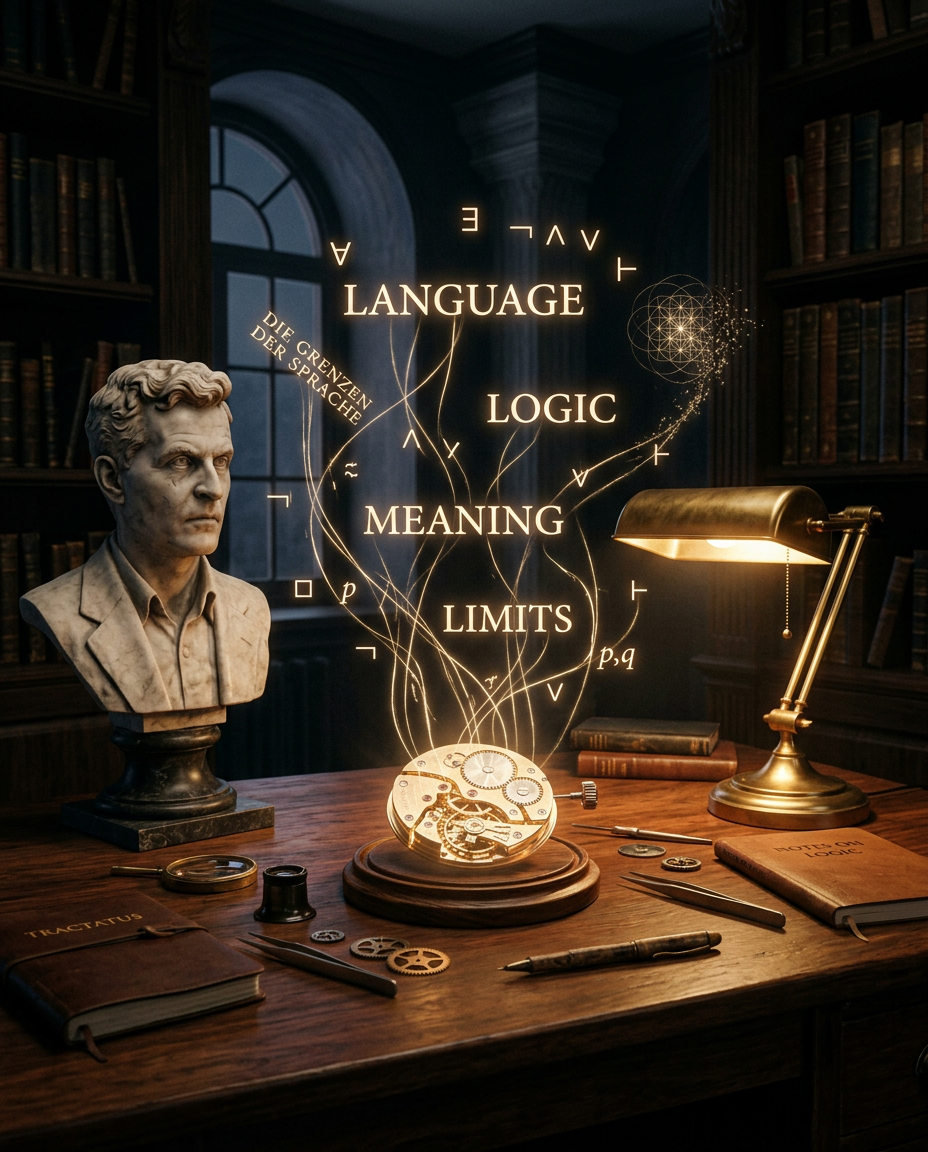
If Kant explored the framework through which experience becomes ordered, Ludwig Wittgenstein turned his attention to another question: how language shapes our understanding of reality.
Philosophers often attempt to describe the nature of the world through words and logical statements. Yet Wittgenstein recognised that language does not simply mirror reality. Words operate within systems of meaning, shaped by context, culture, and the ways people use them.
In his early work, Wittgenstein suggested that language functions by forming logical pictures of the world. Later in his career, he refined this view, arguing that meaning arises through what he called “language games” — the practical contexts in which words are used.
His insight was profound: many philosophical puzzles arise not because reality is mysterious, but because language is being stretched beyond the situations in which it works clearly.
Questions about time, identity, and existence often become tangled because language tends to treat things as static objects. We speak of “time,” “the present,” or “the self” as though they were fixed entities, when in reality they may refer to ongoing processes.
Constant Time Theory offers an interesting perspective on this problem. If reality is continually renewed through the temporal field, then many of the concepts we use to describe the world may be attempting to capture a dynamic process using static language.
Language naturally assumes that things persist unchanged through time. Yet in a renewing universe, what persists is not the matter itself but the informational patterns that are repeatedly reinstantiated as the present renews.
In this sense, Wittgenstein’s insight helps illuminate why discussions about time often become confusing. Our language evolved to describe stable objects, but reality may be fundamentally process-based and continuously renewed.
Constant Time Theory, therefore, suggests that some philosophical puzzles are not simply problems of physics or metaphysics. They are also problems of how language attempts to describe a renewing reality.
CARLO ROVELLI
Does Time Really Exist?
Rovelli and the Disappearance of Time
In recent years, physicist Carlo Rovelli has argued that our ordinary understanding of time may be deeply mistaken.
In everyday life, time appears to flow continuously from past to future. Clocks tick, events unfold, and we experience a present moment moving steadily forward. Yet modern physics presents a far more complicated picture.
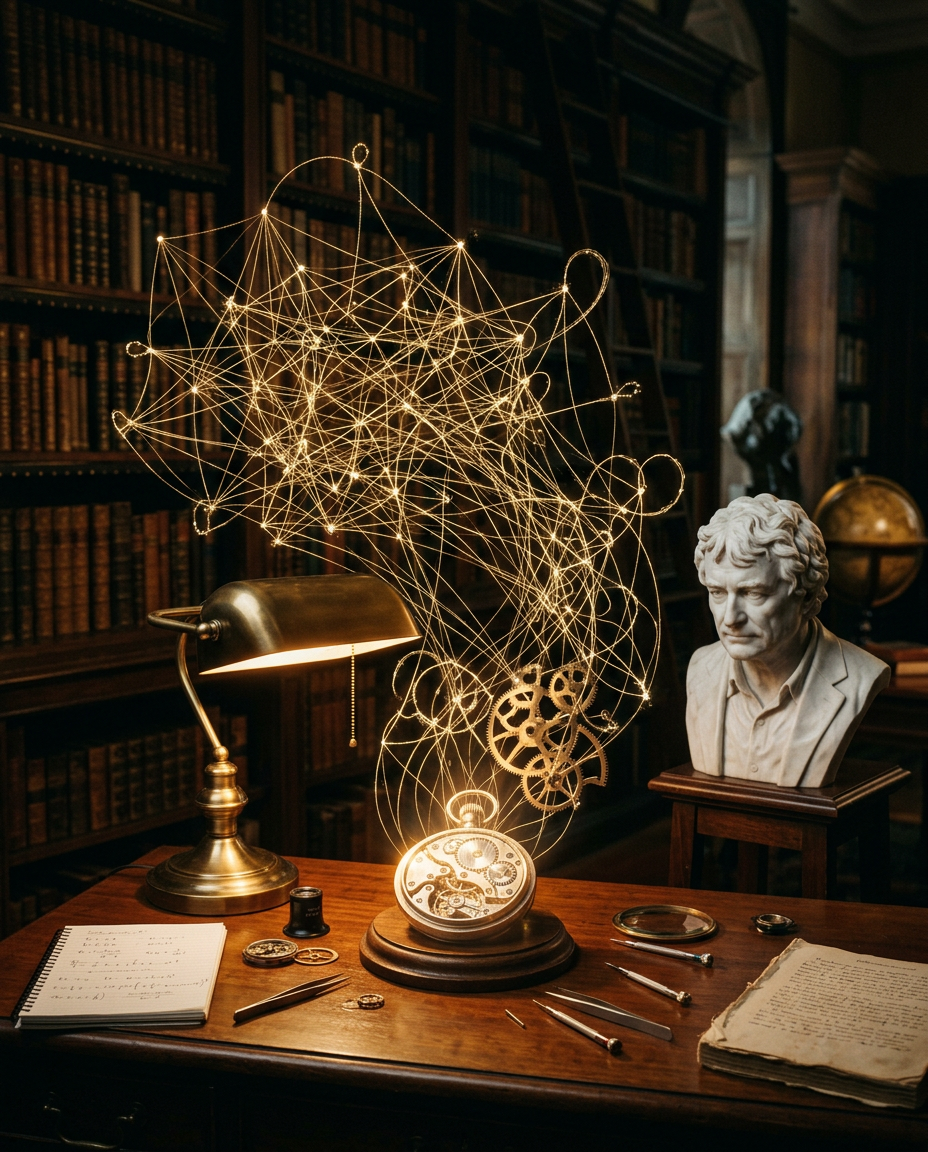
Rovelli’s work in quantum gravity suggests that time may not exist as a universal background against which events occur. Instead, the universe may be composed of networks of relationships between events, where what we call “time” emerges from these relations rather than existing as a fundamental feature of reality.
In this view, the familiar flow of time may be more a feature of how we perceive the world than a basic property of the universe itself.
This idea echoes a long philosophical tradition that questions whether time truly flows at all.
Yet the disappearance of time raises a difficult question. If time is not fundamental, what provides the causal ordering that allows events to occur, processes to unfold, and change to take place?
Every transformation in the universe — from the motion of galaxies to the firing of neurons in the human brain — depends upon a sequence of causes and effects.
Constant Time Theory approaches this problem from the opposite direction. Rather than removing time from the foundations of reality, CTT proposes that time is the most fundamental element of all, operating as a temporal field that continually renews the present moment.
Within this field, causal relations between events are preserved through the structuring mode of time (Θ_S), while the renewing mode (Θ_E) continually reinstantiates reality.
In this sense, Rovelli’s work performs an important role. By questioning the familiar notion of flowing time, modern physics opens the door to rethinking the foundations of temporal reality.
Constant Time Theory suggests that what disappears in Rovelli’s analysis is not time itself, but the classical picture of time as a passive background. In its place may lie something more fundamental: a temporal field responsible for the continual renewal and ordering of reality.
Across centuries, philosophy has approached the nature of reality from many directions. Plato saw enduring patterns behind change. Locke wrestled with the persistence of identity. Kant explored the conditions that make knowledge possible. Wittgenstein revealed the limits of language in describing the world, while modern thinkers such as Carlo Rovelli question whether time itself is fundamental.
Each perspective illuminated part of the puzzle. Yet the deeper question remains: what allows reality to persist, change, and be known at all?
Constant Time Theory proposes that the answer lies in the temporal field itself. Rather than flowing like a river, reality is continually renewed through a fundamental temporal process operating at an immense frequency. Through this renewal, stable patterns arise — patterns we recognise as matter, identity, causality, and experience.
Seen in this light, the insights of the great philosophers are not discarded but reframed within a deeper structure of temporal renewal.
The philosophers described the hands of the clock.
Constant Time Theory attempts to reveal the mechanism beneath the dial.